Wednesday, May 31, 2017

Pennsylvania Memorial Day Birding Weekend 2017


It's our annual tradition to spend the Memorial Day weekend camping/birding in Pennsylvania's great outdoors. Spring migration is gradually dying down so it's a perfect time to visit birds in their breeding grounds in Pennsylvania's state parks.

MAY 27, 2017


Our first stop was McDade Trail in the Delaware Water Gap National Recreation Area, an area known for breeding Cerulean Warblers. A Cerulean Warbler is a small songbird, as the name suggests, whose upper body is covered in beautiful pale cerulean blue with white patches. It is usually difficult to spot as it likes to stay on top of tall forest trees. Unfortunately, due to habitat destruction, the population of this little migratory songbird has declined by staggering 70 percent in the last 40 years, making it one of the most threatened wood warbler species in the country. You can read more about Cerulean Warblers and its recovery effort at the American Birding Association's site.

As soon as we got out of the car, we were inundated with the wonderful buzzy sounds of CERULEAN WARBLER songs. They were literally everywhere and it was hard to contain our excitement.


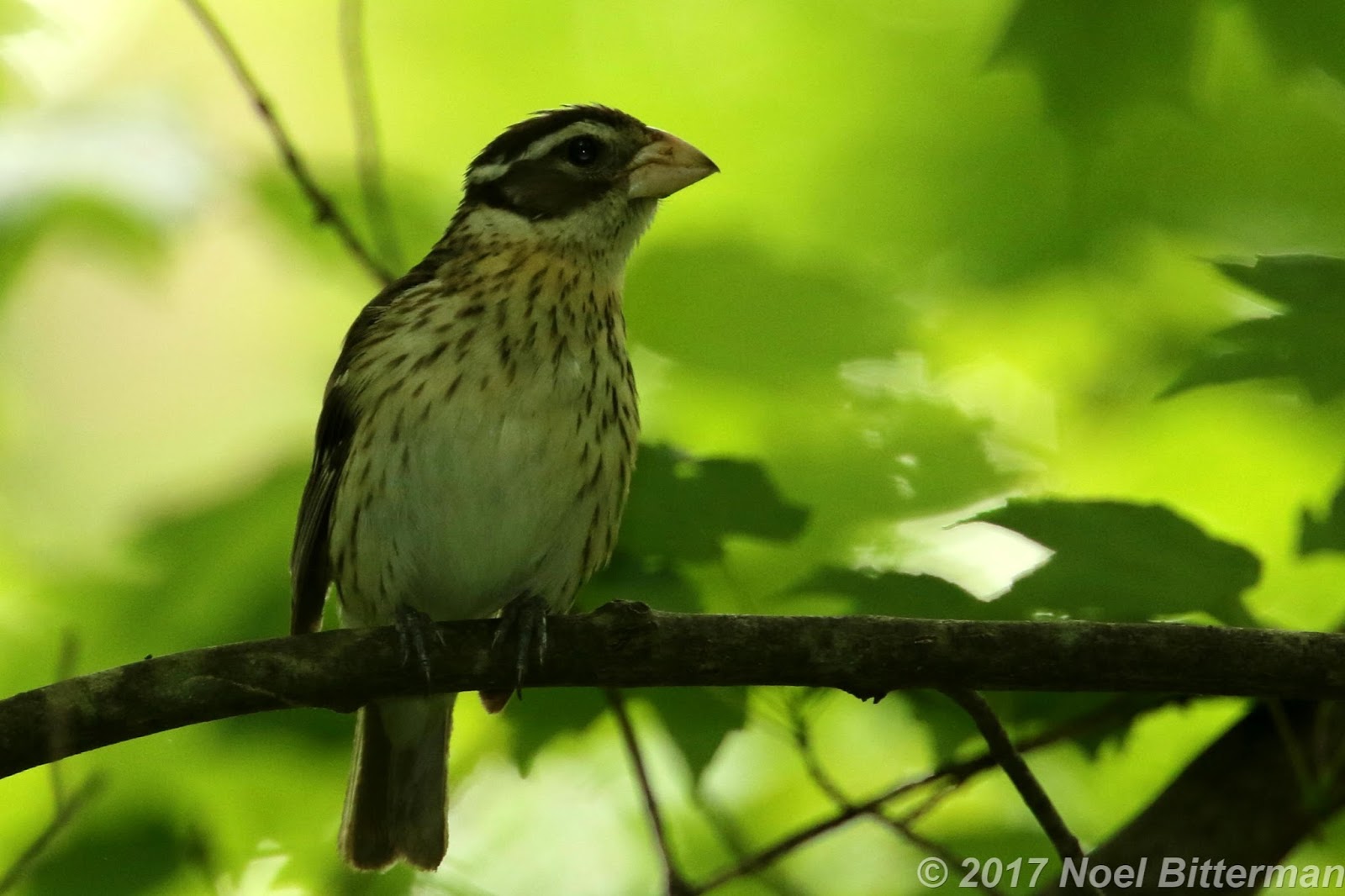
After spending good amount of time admiring our main attraction, we proceeded to explore the rest of the trail which was filled with many exciting avian species. We saw gorgeous WORM EATING WARBLERS, BLUE-WINGED WARBLER, HOODED WARBLER, BLACK-AND-WHITE WARBLER, YELLOW WARBLERs, AMERICAN REDSTARTs, YELLOW-THROATED VIREO, VEERY, BLUE-GRAY GNATCATCHERs, RED-EYED VIREOs, ROSE-BREATED GROSBEAKs, GRAY CATBIRDs and NORTHERN CARDINALs.


After the very satisfying birding hours at McDade Trail, we were on our way to Frances Slocum State Park where we will be camping for the next two nights. We'd been so busy birding that we had not had a chance to eat so we decided to grab a quick bite at a local cafe, KB's Coffeehouse, in Shavertown. By sheer luck, MOURNING DOVEs were nesting right on their front porch and we got to see two scrawny baby doves.


With our bellies full and re-energized, we arrived at Frances Slocum State Park and immediately proceeded to bird around the park. Though the park was filled with birds, they were mostly the usual suspects (YELLOW WARBLERs, RED-WINGED BLACKBIRDs, EASTERN BLUEBIRDs, CEDAR WAXWINGs, BLUE-GRAY GNATCATCHERs, CHIPPING SPARROWs, SONG SPARROWs, GRAY CATBIRDs and AMERICAN ROBINs) so our plan for tomorrow is to visit Ricketts Glen State Park where we know for sure we could find breeding Prairie Warblers.


MAY 28, 2017


There is no better feeling than being woken up by the sound of Wood Thrushes. They were the last ones to be heard late last night and the first ones to start our day. We say Americans work hard but how about them Wood Thrushes! Thanks to the hard-working Wood Thrushes, we were up before 6am and shortly after headed to the Hayfield area in Ricketts Glen State Park 30 miles away. Just like the Ceruleans at McDade Trail, we heard PRAIRIE WARBLERs singing as soon as we got out of the car. Unlike the Ceruleans, Prairie Warblers generally like to hang out in shrubby areas with low trees so one would think it would be easy to spot them, especially when they are singing their hearts out. Well not so fast. It took us good half an hour of searching to finally take a good look at one and boy was the wait worth it!


We spotted quite a few good species around the Hayfield besides the Prairie Warblers, such as BLACK-BILLED CUCKOO, COMMON YELLOWTHROATs, YELLOW WARBLERs, ALDER FLYCATCHERs, CEDAR WAXWINGs, EASTERN BLUEBIRDs, FIELD SPARROWs, CHIPPING SPARROWs, SONG SPARROWs, and TREE SWALLOWs.


Our next stop was State Game Lands 57 adjacent to Ricketts Glen State Park. We always had good luck there with BLACK-THROATED GREEN WARBLERs as well as CHESTNUT-SIDED WARBLERs and this year was no exception. We also saw ALDER FLYCATCHERs, LEAST FLYCATCHERs, EASTERN PHOEBEs, YELLOW WARBLERs, RED-WINGED BLACKBIRDs, CEDAR WAXWINGs and ,as an added bonus, a BEAVER swimming in the lake,


We had been birding for almost 7 hours non-stop and it was time for our late lunch. We stopped by Strevig's Family Restaurant in Benton for a satisfying meal then headed back to Frances Slocum State Park. We even managed to play some tennis at Dallas Sr High School. We ended this wonderful day with nice campfire in the spirit of Memorial Day.


MAY 29, 2017


Instead of waking up to the lovely calls of Wood Thrushes, we were woken up by the sound of rain drops hitting our tent this morning. As you can imagine, it's much harder to bird in the rain, as most birds seek refuge under the trees and stay inactive. The forecast was to rain all day so under the circumstance, we decided to go for quality over quantity and to visit McDade Trail once again for more Ceruleans. Expectedly, it was much harder than 2 days ago to find any birds but we miraculously managed to get best-ever looks of Cerulean Warblers. What do we always say? 'Perseverance is king' or was it more like 'the luck of the Irish'!


Thursday, February 23, 2017

New England Presidents' Day Birding Trip 2017


Planning this trip was not easy. As usual, we wanted to see new and interesting birds but we only had four days to travel so it had to be someplace close and preferably within driving distance. Yes, I admit I am deathly afraid of flying (a debilitating phobia for a birder) so I try to avoid air travel for shorter trips as much as I can. Now we were looking at places within 5-hour driving range all around New York City and after much research, concluded to head north in search of winter specialties. We picked three unseen species to find on this trip, Evening Grosbeak, Pine Grosbeak and Bohemian Waxwing. Now let the fun begin!

FEB 18, 2017


We left Brooklyn before 7am to get to the Chubby Bunny Farm in Falls Village, CT. Supposedly, Evening Grosbeaks regularly visit their feeder in the morning. While driving to get to the farm, we were quite taken aback how rural and beautiful this part of Connecticut was. We arrived at the farm around 9am and there were already hundreds of birds feeding at the feeding stations strategically setup all around the property. However, there was no sign of Evening Grosbeak. At first, we thought to drive on Cobble Road in search of the bird but parts of the road had too much snow so we decided to walk instead.


After walking for 5 minutes, we saw a beautiful female EVENING GROSBEAK in a tree alongside the road. Soon we realized that there were three female Grosbeaks making their way onto the feeder at the house. As we followed the birds back to the farm house, we met a couple visiting all the way from Philadelphia to see the birds. Grosbeaks stayed on top of a tree by the house for about 20 minutes before coming down to feed. They basically shushed all the birds away from the feeder and gorged themselves with tasty sunflower seeds and we all thoroughly enjoyed the view. Sure it would have been nice to see a male but that has to wait till next time. They left the feeder before 10:30am and that was their fill at the feeder for the day


We also saw many common birds around the house including WHITE-THROATED SPARROWs, BLACK-CAPPED CHICKADEEs, AMERICAN GOLDFINCHes, AMERICAN TREE SPARROWs, TUFTED TITMOUSE, AMERICAN ROBINs, CARDINALs, DOWNY WOODPECKER, HOUSE SPARROWs, BLUE JAYs and AMERICAN CROWs.


Our plan was to leave the area to head north once we found the Grosbeaks. Happy to report, finding the Grosbeaks happened sooner than expected so we now had an option to drive further north to Hanover, NH where many Bohemian Waxwings were sighted. Due to the nature of this trip that bird sightings dictated our whereabouts, we did not make any hotel reservations. I checked for rooms less than two days ago and there were still enough left so we weren't too worried. Well, little did we know, all the rooms in Vermont were completely booked up. I suppose this was the biggest ski weekend and Vermont was the place to be. After much searching, we found one room at Quality Inn in Brattleboro, VT. Brattleboro was not north enough to see Waxwings nor Pine Grosbeaks so we made some random stops before getting to the hotel. The first stop was a town park called Madame Sherri Forest. Unfortunately, the park was covered deep in snow so we could only walk for a short distance and we did not see a single feathered soul though met some snowshoers and their canine companion.


We then stopped at the Wastewater Treatment Plant in Keene, NH, following the report of a Northern Shrike sighting. We did not see the Shrike but it was nice to walk on a road without snow for a change. It was getting dark so we headed back to the hotel. As expected, it was packed with skiers.


FEB 19, 2017


We knew that today was going to be a challenging day with one ambitious goal in mind: find Bohemian Waxwings. We plan to visit as many sites as possible where Waxwings' sightings were reported in the last two weeks. Unlike Grosbeaks, Waxwings do not feed at feeders and tend to move from place to place usually in a large flock so 'being at the right place at the right time' was crucial to finding them. In other words, we needed luck, a lot of it. We visited about 5 different locations where they were recently seen and the closest we came was a small flock of CEDAR WAXWINGs. Cedar Waxwings are very similar to Bohemian Waxwings in appearance and are fairy common all around the county. Well, I think one of the reasons that makes birding so addictive is that there is no guaranteed outcome and as such, we are always kept in suspense. Today was not the day for us but we still had the rest of the trip to hopefully run across this wonderful species.


Before going on this trip, I signed up for the Vermont Rare Bird Email Alert and it paid off. The email alerted us that a flock of Pine Grosbeaks were seen at a residential address in a small village of Strafford not too far from where we were so we decided to investigate. It is always tricky to bird near a personal residence. Surely, we do not set a foot on anyone's property but we may look at a bird on top of a tree planted in their property through binoculars. Just last month, a birder told us that in upstate New York, the owner of the house came out with a gun when the birder was looking at a bird on his property. So we carefully walked on the road looking for the PINE GROSBEAKs. Then there they were: one gorgeous male and ten+ females in one tree by a barn. They flew away soon after but they sure made quite a impression on us.


FEB 20, 2017


After our 6am breakfast at the hotel in Barre, we headed straight to the riverside shopping area in Montpelier where numerous Pine Grosbeak sightings had been reported. We quickly spotted a flock foraging on a low tree with small red berries. No wonder Pine Grosbeaks were consistently seen here. Those trees with red berries were planted everywhere in this small shopping / parking area. We had heard that they were often not afraid of people and that really was true. They were so focused on eating that nothing seemed to bother them including our presence. They moved from tree to tree and were gone before 10am. Seeing those beautiful Pine Grosbeaks up close certainly was the highlight of our trip.


It was still early in the day then we saw a report of a Boreal Chickadee at Moose Bog in the Wenlock Wildlife Management Area. Don't start with me on Boreal Chickadees. I call them my *grail* birds. I had unsuccessfully looked for this Boreal specialist a few times in the past (often traveling great distances). Basically all our trips to Adirondacks were to see this very species and in the end, the bird broke my spirit. I purposely omitted Boreal Chickadees from the target bird list for this trip because I did not want to be disappointed again. I remembered that the birder we met at the Chubby Bunny Farm also said that she had seen both a Spruce Grouse and a Boreal Chickadee at Moose Bog. So there began our *unofficial* part of the trip.


As soon as we got to the Wildlife Management Area, we were greeted by numerous Black-capped Chickadees. Black-capped Chickadees can be very tame and are known to feed from human hands and it was clear that they were all waiting for us to feed them sunflower seeds. We did not have what they were after but one thing we had was that gut feeling that Boreal Chickadees were nearby as they most always hang out with their Black-capped cousins. When we heard unfamiliar sounds coming from the tree top, we jumped up in joy. Oh there it was, foraging busily among Black-capped Chickadees, I finally saw a BOREAL CHICKADEE!!! Encouraged with our very first sighting of a Boreal Chickadee, we decided to take the trail leading to the Moose Bog hoping / praying we would get a glimpse of a critically endangered, immensely sought-after Spruce Grouse. Well, we could not get that lucky but did meet three locals feeding GRAY JAYs at the Bog. As an added bonus, we saw a juvenile NORTHERN SHRIKE on top of a very tall tree. What a day it had been.


FEB 21, 2017


Unfortunately, we had to make our way back home to Brooklyn today. But before that, we had some important unfinished business to take care of. We spent last morning hours in Vermont looking for Bohemian Waxwings. Again, we visited places around Hanover where their sightings had been reported and we came out empty. Well, it just wasn't meant to be this time. We then drove down to the area in CT where we saw Evening Grosbeaks, hoping to catch a sight of a male. However, we knew that Evening Grosbeaks were usually seen earlier in the day so the chance of seeing them was slim and we were, unfortunately, right. Along the way, we caught a sight of some more common birds: EASTERN BLUEBIRDs, WHITE-BREASTED NUTHATCHes, TUFTED TITMOUSEs, and MOURNING DOVEs. 


Throughout the trip, we were in constant awe of those amazing feathered creatures thriving in the bitter cold northern New England. We are sure to be back to this magical winter wonderland.

UPDATE


FEB 25, 2017


Sexual dimorphism is the condition where the two sexes of the same species look different and is frequently observed in the avian world. Often times, male birds are more colorful with fancier plumage than their female counterparts. Evening Grosbeaks certainly fall into the category. So when we ticked off Evening Grosbeaks from our *life* bird list, something just didn't sit quite right as we only saw females, Somehow we felt that we needed to find a male to complete the list and that's just what we did. We drove to the same area in Connecticut where we saw female Grosbeaks a week earlier. We had spent a good three hours checking out locations where they were recently seen but came up empty. Well, that was not going to stop two determined birders. Our next not-so-efficient strategy was to stop for any sign of bird activity along the road and that desperation technique paid off. We stopped along Under Mountain Road and finally hit a jackpot. We saw a flock of Evening Grosbeaks (perhaps 15 or more) and there he was, showing off his bold yellow streaks above his eyes. Now we can finally put an end to our quest to find this beautiful species.